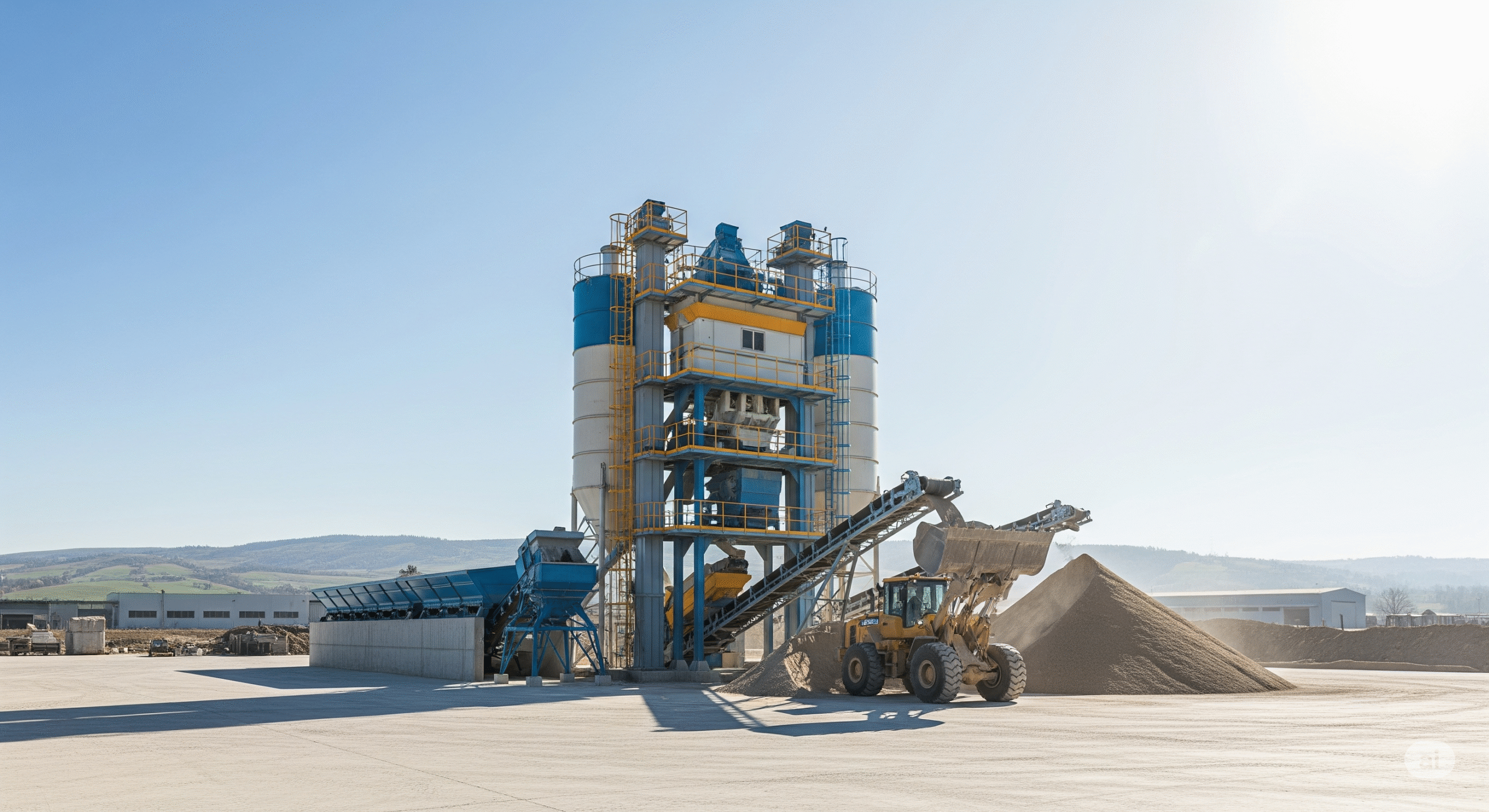
Conveyor belts are critical material handling equipment that form the backbone of aggregate transportation systems in concrete batching plants. They serve as the primary link between aggregate storage hoppers and the concrete mixer, ensuring continuous and controlled material flow essential for consistent concrete production. The conveyor belt system transports aggregates of various sizes—ranging from coarse aggregates (stones) to fine aggregates (sand)—from the stockpile area through the batching and weighing system directly to the mixer.
In a concrete batching plant, efficient and reliable movement of raw materials is essential for consistent concrete quality and high production rates. Conveyor belts are one of the most commonly used systems for transporting aggregates (sand, gravel, crushed stone) from storage bins or hoppers to the concrete mixer.
A conveyor belt system provides a continuous, automated flow of material, reducing manual labor and minimizing spillage or segregation of aggregate sizes.
Applications of Conveyor Belts in Concrete Batching Plants
- Transport of Aggregates from Storage Bins to Weighing Hopper
Conveyor belts are commonly used to carry aggregates such as sand, crushed stone, and gravel from ground-level aggregate bins to the weighing hopper.
- Feeding Aggregates Directly into the Mixer
In many modern batching plants, conveyor belts transport weighed aggregates directly into the mixer (pan mixer, twin-shaft mixer, or planetary mixer).
- Inclined Aggregate Lifting
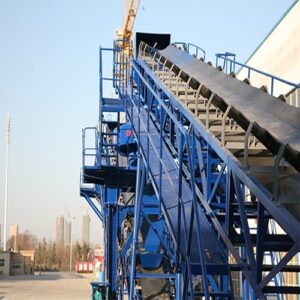
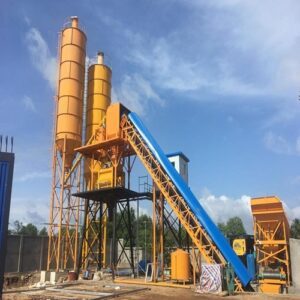
Conveyor belts are widely used to lift aggregates to higher elevations, especially in plants where the mixer is positioned above ground level.
- Use in Mobile and Compact Batching Plants
In mobile and compact batching plants, conveyor belts are preferred due to their lightweight structure and flexibility.
- High-Capacity Aggregate Handling in Large Plants
For high-output batching plants, conveyor belts are designed to handle large volumes of aggregates continuously.
- Controlled and Dust-Reduced Material Transport
Conveyor systems can be fitted with covers, skirting, and dust seals, making them suitable for plants operating in urban or environmentally regulated areas.
- Integration with Automation and Control Systems
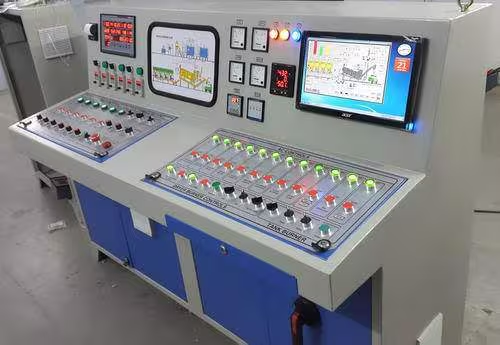
Conveyor belts are integrated with PLC-based control systems to coordinate aggregate movement with batching sequences.
Materials of Construction for Conveyor Belts in Concrete Batching Plants for Aggregate Transport
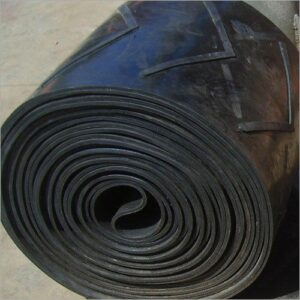
Conveyor belts used in concrete batching plants for transporting aggregates to the mixer consist of multiple material layers, each selected for specific functional requirements. Understanding the material composition is essential for ensuring durability and optimal performance in the demanding environment of aggregate material handling.
Belt Body (Carcass)
EP (Polyester–Nylon) fabric – most commonly used
- High tensile strength
- Low elongation
- Good impact resistance
NN (Nylon–Nylon) – used in heavier-duty applications
Belt Cover
- Natural rubber / Synthetic rubber (SBR / NR blend)
- Abrasion resistant
- Cut and tear resistant
- Weather and moisture resistant
Typical grade:
- M24 or higher abrasion-resistant grade
Belt Structure and Layered Composition
A modern conveyor belt system is a multilayered composite structure comprising three primary components: the top (cover) rubber layer, the carcass core, and the bottom (cover) rubber layer. This layered construction ensures the belt can withstand the mechanical stresses, abrasion, and impact forces generated during continuous aggregate transport and discharge into the mixer.
Rubber Cover Materials
The top and bottom surfaces of the conveyor belt are constructed from specialized rubber compounds designed to provide friction, impact resistance, and durability. The primary rubber materials used include:
Natural Rubber (NR): Natural rubber remains the preferred choice for conveyor belt covers in many applications, particularly for aggregate handling. It provides excellent elongation at break, tear resistance, and inherent elasticity essential for withstanding impact from falling aggregate onto the belt surface. Natural rubber compounds for conveyor belts typically contain 100 parts per hundred rubber (phr) of base rubber, with additional additives to enhance performance.
Synthetic Rubber Compounds: Synthetic rubbers such as styrene-butadiene rubber (SBR) and ethylene propylene diene monomer (EPDM) are often blended with natural rubber to enhance specific properties. EPDM blends are particularly useful for conveyor belts that operate in higher temperature environments, with formulations capable of maintaining integrity at temperatures up to 150-160°C under normal conditions. For enhanced thermal resistance in harsh conditions, EPDM-based systems have been developed that maintain performance at temperatures up to 200°C when combined with silica fillers and paraffinic oils.
Pre-vulcanized Rubber Modifications: Advanced belt designs employ pre-vulcanized natural rubber (PNR) blended with fresh natural rubber matrices to create self-reinforced rubber composites. When 20% of the rubber is pre-vulcanized before mixing with the NR matrix, tear strength increases by 34.1%, stress at 300% elongation improves by 16.6%, and wear resistance increases by 10.2%, while maintaining elongation at break around 898%.
Rubber Filler Materials
The rubber cover compounds incorporate filler materials to enhance mechanical properties and durability:
Carbon Black: Traditionally the primary filler material, carbon black is added in specific grades (ISAF, HAF, FEF types) to strengthen rubber compounds. Carbon black fillers significantly improve tensile strength, hardness, tear resistance, and abrasion resistance. Typical carbon black addition results in tensile strength values of 70 kg/cm², elongation at break of 320%, tear resistance of 36 kg/cm², Shore A hardness of 62, and abrasion resistance of 1.1 mm/kgm.
Silica: Silica fillers are used to improve tensile properties and enhance thermal stability. Silica loading in EPDM rubber compounds increases physico-mechanical characteristics while improving heat resistance. The addition of silica with paraffinic oil helps achieve higher temperature performance in conveyor belt formulations.
Alternative Fillers: Researchers have explored coconut shell charcoal and mica as potential replacement or supplementary fillers, though these have not yet matched the performance of traditional carbon black or silica for aggregate transport applications.
Carcass and Reinforcement Materials
The core structure of the conveyor belt provides tensile strength and load-bearing capacity. The carcass comprises multiple fabric plies made from synthetic fibers:
Polyester Fabric: Polyester is one of the most commonly used carcass materials in modern conveyor belts for aggregate applications. Polyester provides excellent tensile strength, dimensional stability, and compatibility with rubber compounds. Polyester plies are typically woven into fabrics and dipped in resorcinol-formaldehyde-latex (RFL) adhesive systems to enhance bonding with the rubber cover layers.
Polyamide (Nylon): Polyamide 66 fabric is frequently used in combination with polyester to create polyester/polyamide (EP) blended fabric carcasses. This combination provides enhanced elasticity and impact resistance, making it particularly suitable for aggregate transport where material impact is significant.
Aramid Fibers: High-performance conveyor belts for heavy-duty aggregate transport may incorporate aramid fiber reinforcement for increased tensile strength and load-bearing capacity.
Multiple Ply Arrangement: Modern conveyor belts typically employ 2 to 6 fabric plies depending on the required belt strength and tensile rating. The tension between plies and rubber is critical—adhesion strength tests verify that the rubber has adequate grip on the fabric. Adhesion is assessed according to ISO 252:2007 and ISO 14890:2013 standards, ensuring the belt will not delaminate under operating stress.
Steel Cord Reinforcement Systems
For very high-capacity concrete batching plants handling heavy aggregate loads, steel cord reinforcement may be employed instead of fabric plies. Steel cord belts consist of longitudinal steel wire ropes embedded in rubber, providing significantly higher tensile strength and load capacity compared to fabric conveyor belts. The steel cords are surrounded and protected by the rubber cover material, preventing corrosion and ensuring belt integrity. The strength of steel cord belts is determined by the number and diameter of the steel cords, with design considerations for load distribution and splice strength.
Adhesion and Bonding Systems
The critical interface between rubber covers and the carcass fabric must maintain structural integrity under continuous stress and impact loading. Resorcinol-formaldehyde-latex (RFL) treatments are applied to woven fabrics before vulcanization, creating a chemical bond between the synthetic fiber and rubber matrix. The vulcanization process, optimally conducted at 160°C for 35 minutes, significantly influences the final tensile strength of the rubber-carcass assembly, with improper vulcanization temperature reducing strength by up to 89%.
For steel cord systems, the rubber-to-steel adhesion is enhanced through specialized coating systems that chemically bond the rubber to the steel surface, preventing slippage and ensuring load transfer across the belt splice joints.
Mechanical Property Specifications
Conveyor belts for aggregate transport in concrete batching plants must meet stringent mechanical property requirements:
Tensile Strength: The combined rubber-carcass structure must demonstrate tensile strength sufficient for the belt's rated load capacity. Fabric belt tensile strengths vary based on cover thickness and ply count, with typical values ranging from 100 to 400 N/mm depending on design.
Abrasion Resistance: The top cover rubber must resist wear from sharp aggregate edges. Abrasion resistance is measured as material loss (mm/kgm) when subjected to standard abrasion testing. Superior compounds show abrasion resistance values less than 0.5 mm/kgm.
Tear Strength: Tear propagation resistance prevents small punctures or cuts from developing into belt failure. Natural rubber covers provide superior tear strength due to their inherent elasticity and molecular structure.
Hardness: The rubber cover must maintain appropriate hardness (typically 50-65 Shore A) to provide friction with the drive pulley while remaining flexible enough to deform over idler rollers without damage. Excessive hardness increases rolling resistance and energy consumption.
Impact Resistance: The rubber must absorb energy from material impact without developing cracks or permanent deformation. Dynamic loading tests evaluate the ability of rubber compounds to withstand repeated impact from aggregate discharge.
Service Life and Degradation Characteristics
The materials composition directly influences the service life of the conveyor belt. Thermal aging studies reveal that rubber compounds degrade at different rates depending on temperature exposure. The activation energy for degradation has been quantified, allowing prediction of remaining service life based on observed hardness changes. Rubber compounds subjected to accelerated aging at elevated temperatures show changes in mechanical properties that follow second-order reaction kinetics, enabling calculation of belt life at operational temperatures.
Standards and Certification
Conveyor belt materials for concrete batching plant applications are selected and tested according to international standards:
- ISO 252:2007: Standard for testing adhesion between rubber covers and textile carcass
- ISO 14890:2013: Verification standard for adhesion strength
- DIN 22101: German standard for belt conveyor design and material selection
- EN 28510-1:2014: Peel test standard for adhesive strength evaluation
The material selection for conveyor belts in concrete batching plants represents a balance between cost efficiency, durability requirements, and operational performance. The specific combination of natural and synthetic rubbers, textile or steel reinforcement, and filler materials is tailored to the aggregate type, transport distance, capacity requirements, and environmental conditions of each installation.
Working Principle of Conveyor Belts Used in Concrete Batching Plants for Aggregate Transport to Mixer
The working principle of conveyor belt systems in concrete batching plants is based on fundamental mechanical concepts involving friction, rotational motion, and material dynamics. Understanding this principle is essential for optimizing plant operations and troubleshooting equipment performance.
Basic Operating Mechanism
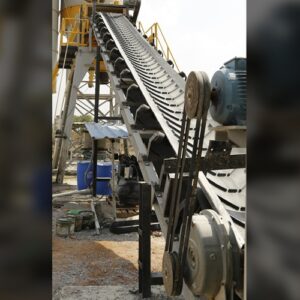
A conveyor belt system operates through the rotation of a drive pulley powered by an electric motor, which creates continuous belt movement. The endless conveyor belt is supported by two main pulleys—the drive pulley (powered by the motor) and an idler pulley (rotates freely at the discharge end)—with multiple support rollers or idlers distributed along the belt's length to prevent excessive sagging under material load. When the motor rotates the drive pulley, friction between the pulley's surface and the belt causes the entire belt loop to move continuously.
Aggregate material fed onto the moving belt near the loading end is transported by frictional grip between the material and the belt surface. As the belt moves, it carries the loaded material along its length to the discharge point where it enters the concrete mixer. The belt then returns as an empty loop underneath the loading run to complete the cycle. This endless loop configuration enables continuous material transport without interruption, which is critical for maintaining consistent concrete production rates.
- Material Feeding
Aggregates are initially stored in separate aggregate bins. When a batch cycle starts:
- Batching gates open according to the required mix design.
- Aggregates fall onto the weighing hopper or directly onto the conveyor belt.
The quantity of material is controlled by the plant’s weighing and control system.
- Drive Mechanism Operation
The conveyor belt is driven by a drive unit, which consists of:
- An electric motor
- A gearbox
- A drive pulley
When the motor starts, it rotates the drive pulley, which in turn moves the belt in a continuous loop.
- Aggregate Transportation
As the belt moves:
- Aggregates rest on the top carrying surface of the belt.
- Idlers/rollers support the belt and load, reducing friction.
- The belt carries the material horizontally or at an incline toward the mixer.
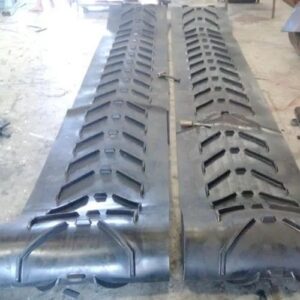
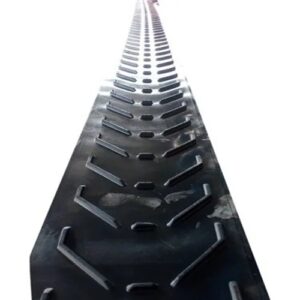
For inclined conveyors, cleats or chevron-pattern belts may be used to prevent material rollback.
- Speed and Flow Control
The conveyor speed is regulated through:
- Motor speed control (VFD, if installed)
- Synchronization with batching and weighing systems
This ensures:
- Uniform material flow
- No overfeeding or underfeeding of the mixer
- Accurate batching and repeatable concrete quality
- Material Discharge into the Mixer
At the discharge end:
- The belt passes over the head pulley
- Aggregates are discharged by gravity
- Material falls directly into the mixer inlet or into a skip/charging hopper
Scrapers or cleaners may be used to prevent material buildup on the belt.
- Return and Tensioning
After discharge:
- The empty belt travels back on the return rollers
- A tensioning system maintains proper belt tension
- Correct tension prevents slippage, misalignment, and excessive wear
- Integration with Plant Automation
The conveyor belt operation is fully integrated with the batching plant control system:
- Starts and stops automatically with each batch
- Interlocked with mixer readiness and batching gates
- Includes safety features such as emergency stop switches and belt misalignment sensors
Summary of Working Principle
- Aggregates are released from bins
- Motor drives the conveyor belt
- Belt carries aggregates toward the mixer
- Speed is controlled for accurate batching
- Aggregates are discharged into the mixer
- Belt returns for the next cycle
Here are the key features of a conveyor belt used in a concrete batching plant for transporting aggregates (sand, gravel, crushed stone) to the mixer.
- Heavy-Duty Belt Construction
Material: Usually rubber (EP/NN reinforced) designed to resist abrasion from sharp aggregates.
Thickness: Thicker top cover to withstand continuous impact and wear.
Weather resistance: UV, heat, and moisture resistant for outdoor operation.
Why it matters: Aggregates are abrasive and heavy; weak belts fail quickly.
- High Load Capacity
- Designed to handle large volumes and high tonnage of aggregates continuously.
- Proper belt width (e.g., 500–1000 mm) ensures smooth flow without spillage.
Benefit: Maintains batching plant output and avoids bottlenecks.
- Inclined Conveying Capability
Often operates at an incline to lift aggregates from ground bins to the mixer hopper.
May use:
- Chevron (patterned) belts to prevent rollback
- Side skirts to contain material
Result: Efficient vertical transport without material loss.
- Accurate and Consistent Material Feed
- Works in coordination with weighing systems and batch controllers.
- Smooth belt motion ensures consistent feed rate to the mixer.
Importance: Ensures correct aggregate proportions for concrete quality.
- Robust Drive System
Equipped with:
- Electric motor
- Gearbox
- Drive pulley with rubber lagging
- Designed for high starting torque under full load.
Advantage: Reliable start up even when belt is fully loaded.
- Anti-Spillage and Dust Control Features
- Skirt boards along loading zone
- Impact rollers or beds under feed point
- Optional belt covers to reduce dust and moisture ingress
Outcome: Cleaner plant operation and reduced material loss.
- Low Maintenance Design
Uses:
- Sealed bearings
- Easily replaceable rollers
- Simple belt tensioning systems
Benefit: Less downtime and lower operating costs.
- Safety Features
- Emergency stop pull cords
- Belt misalignment (sway) switches
- Protective guards on moving parts
Why critical: Ensures operator safety in industrial environments.
- Integration with Plant Layout
Can be:
- Fixed
- Mobile
- Radial or telescopic (in some plants)
Designed to fit specific batching plant capacities (30–240 m³/hr or more).
- Environmental Adaptability
Performs reliably in:
- Hot climates
- Cold regions
- Wet or dusty conditions
Key point: Designed for continuous outdoor industrial use.
Below are the typical technical specifications for a conveyor belt system used in a concrete batching plant to transport aggregates from bins to the mixer. These values are industry-standard and may be adjusted based on plant capacity and layout.
- Conveyor Belt (Rubber Belt) Specifications
- Parameter Typical Specification
- Belt type: EP (Polyester–Nylon)
- Belt grade: M24 (abrasion resistant)
- Belt width: 500, 600, 650, 800, 1000 mm
- Number of plies: 3–5 ply
- Tensile strength: 315–630 N/mm
- Top cover thickness: 5–6 mm
- Bottom cover thickness: 2–3 mm
- Total belt thickness: 8–12 mm
- Belt speed: 8 – 1.6 m/s
- Maximum inclination: 18° (plain belt), up to 22° (chevron belt)
- Conveyor Capacity (Typical)
Belt Width (mm) Capacity (TPH)*
500: 80–120
650: 150–250
800: 300–450
1000: 500–700
* Capacity depends on belt speed and material bulk density (~1.5–1.7 t/m³).
- Conveyor Length & Inclination
- Length: 6 m – 30 m (typical batching plants)
- Inclination angle: 12°–18°
- Feed height: As per aggregate bin and mixer position