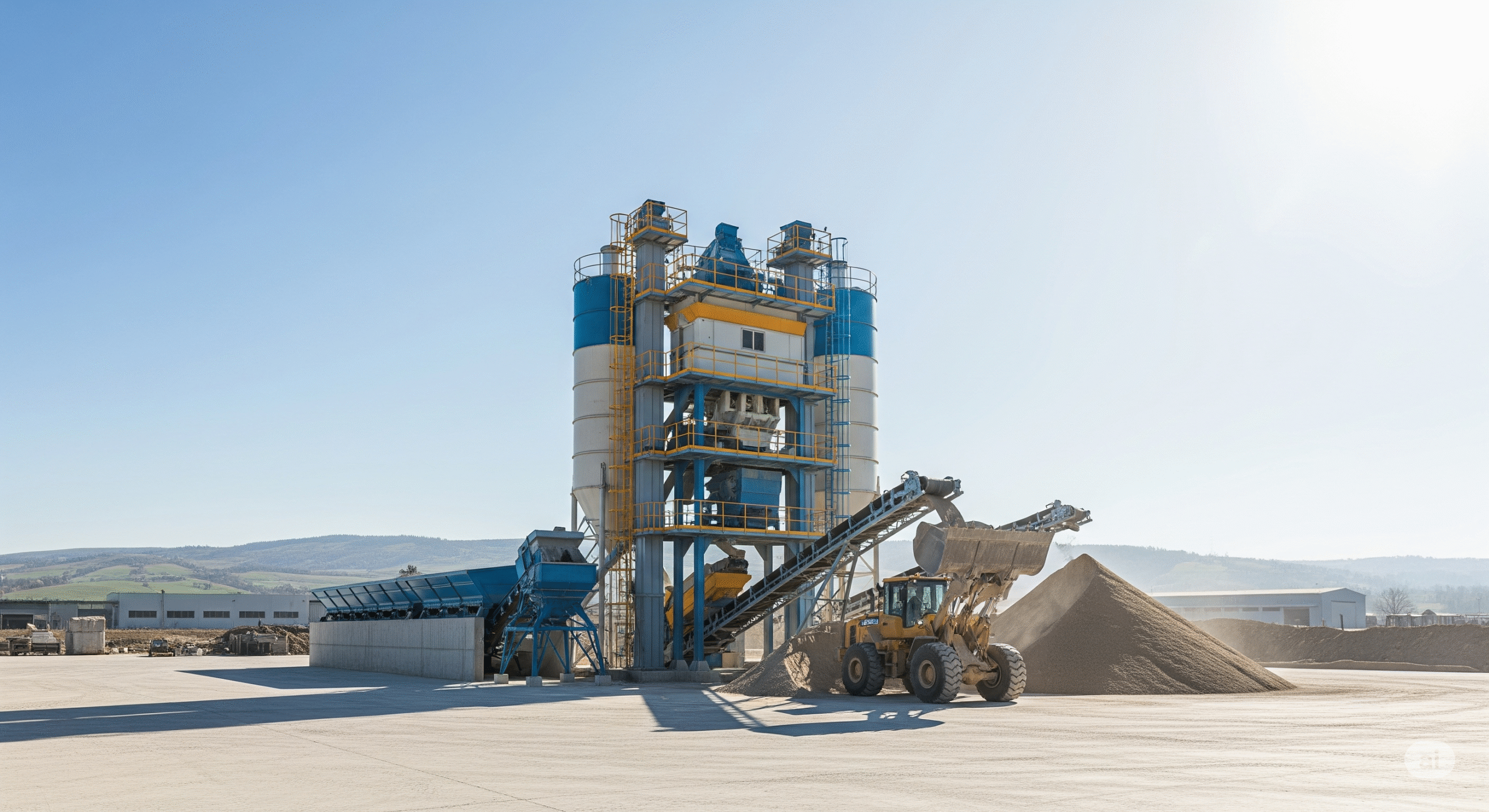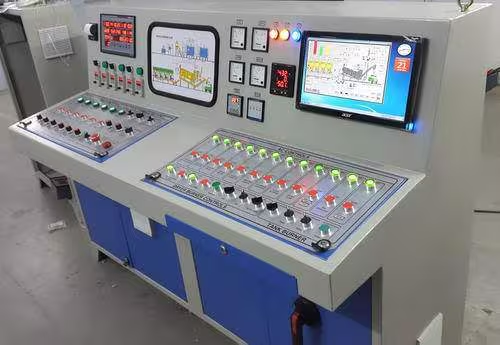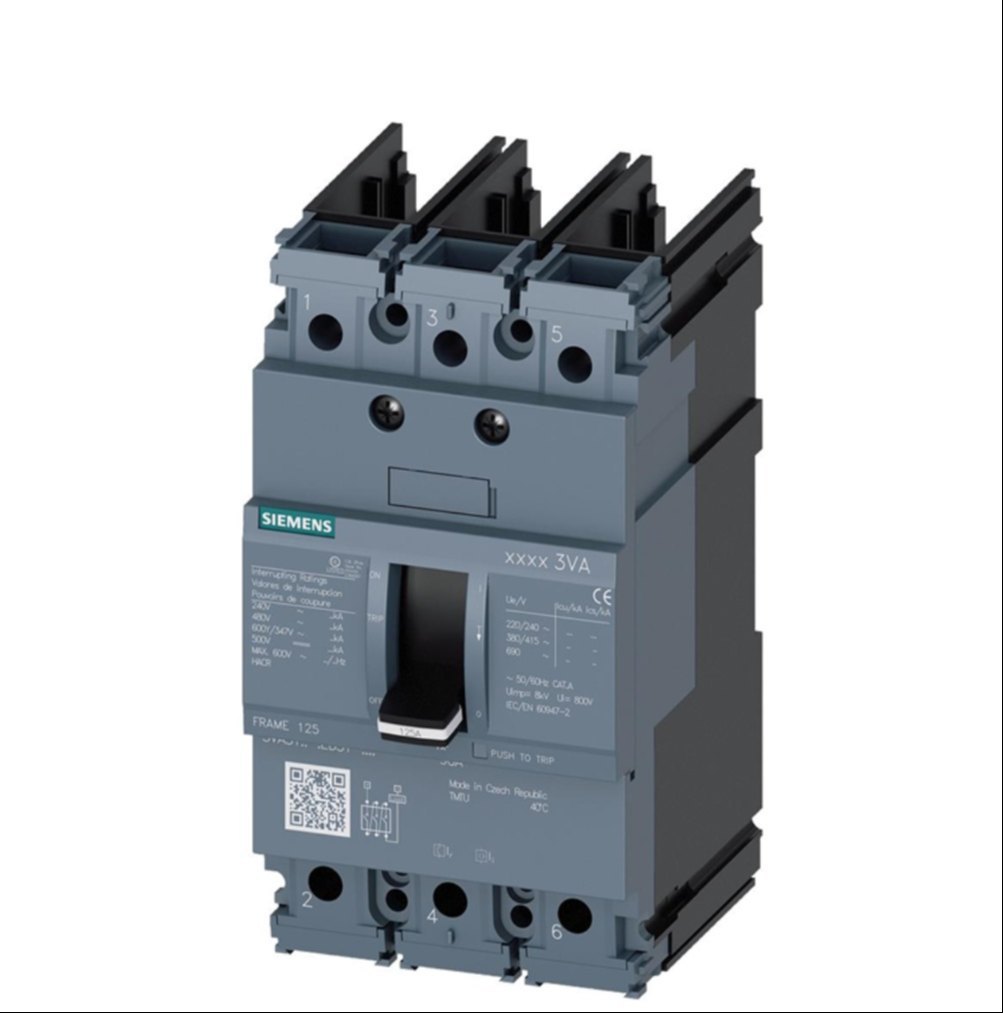
Aggregate batching gates are precision control mechanisms installed in concrete batching plants to regulate the discharge and proportioning of coarse aggregates (gravel/stone) and fine aggregates (sand) from their respective storage silos into the batching system. These mechanical or electro-pneumatic devices are essential components that control the flow rate, timing, and quantity of each aggregate type, ensuring accurate material proportioning according to the concrete mix design specifications.
In ready-mix concrete production, aggregates constitute 70-80% of the concrete volume, making the accuracy of aggregate batching critical to the final concrete quality, consistency, and performance. Aggregate batching gates directly influence the precision of material measurement, production efficiency, and the ability of batching plants to maintain quality standards consistently.
Typically installed at the bottom of aggregate bins or pre-feed hoppers, these gates are operated by pneumatic cylinders, hydraulic systems, or electric actuators. Modern plants often use dual-stage (coarse and fine) aggregate batching gates, allowing rapid filling at the start of batching and precise weight correction at the final stage.
Aggregate batching gates are designed to withstand abrasive materials, heavy impact loads, and high cycle frequencies, while minimizing material spillage, segregation, and dust generation. Their performance plays a key role in reducing batch cycle time, improving weighing accuracy, and ensuring smooth plant operation.
In summary, aggregate batching gates serve as the primary flow-control and metering devices for aggregates in concrete batching plants, forming a vital link between material storage and accurate concrete production.
Aggregate batching gates are widely used wherever controlled, accurate, and repeatable dosing of aggregates is required in concrete production. Their applications extend across different plant types, production scales, and construction sectors.
- Ready-Mix Concrete (RMC) Plants
- Control batching of sand, gravel, and crushed stone
- Ensure consistent concrete quality for commercial supply
- Enable fast production cycles for high-volume output
- Precast Concrete Plants
- Used in batching aggregates for:
- Beams
- Columns
- Slabs
- Pipes
- High accuracy is essential to maintain dimensional stability and strength
- Often integrated with automated batching systems
- Infrastructure & Mega Construction Projects
- Deployed in on-site batching plants for:
- Bridges
- Dams
- Tunnels
- Highways
- Handle large aggregate sizes and heavy-duty continuous operation
- Designed for rugged site conditions
- Mobile & Compact Batching Plants
- Installed in mobile and skid-mounted plants
- Allow quick setup and relocation
- Used for remote or temporary construction sites
- High-Strength & Special Concrete Production
- Precise control of aggregate proportions for:
- High-strength concrete
- Self-compacting concrete (SCC)
- Fiber-reinforced concrete
- Fine gate operation ensures accurate trimming
- Aggregate Pre-Batching & Weigh Hopper Systems
- Used in:
- Individual aggregate bins
- Centralized weigh hoppers
- Enable batching of multiple aggregate fractions before mixing
Summary
Aggregate batching gates are essential components used across ready-mix, precast, infrastructure, and mobile concrete batching plants. Their ability to control aggregate flow accurately makes them indispensable for efficient, automated, and high-quality concrete production.
- Regulate the flow of sand, gravel, and crushed stone from aggregate bins
- Prevent sudden or uncontrolled material release
- Ensure smooth gravity flow into weigh hoppers
- Enable precise dosing of aggregates according to mix design
- Maintain correct aggregate proportions in every batch
- Reduce variation in concrete strength and workability
- Essential for quality-controlled concrete production
- Prevent over-batching and spillage
- Minimize leakage through sealed gate design
- Supports continuous and repetitive batching operations
- Used for fine sand to large coarse aggregates (up to 40–60 mm)
- Designed to avoid jamming and segregation
- Ensures uniform material flow
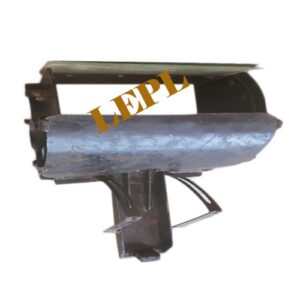
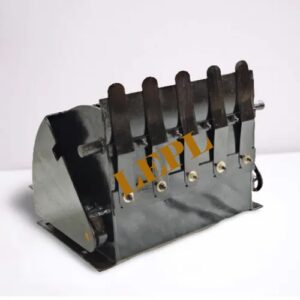
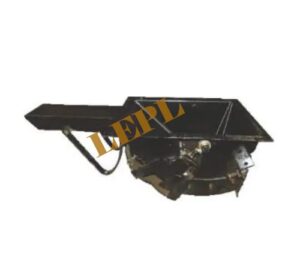
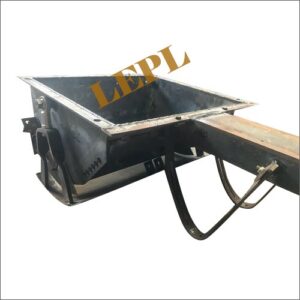
Aggregate batching gates operate on a fundamental principle of controlled material discharge from storage hoppers through regulated opening and closing of gate apertures. The working principle involves the interplay between gravitational force on stored materials, precise timing of gate actuation, weight feedback sensors, and intelligent control algorithms to achieve accurate batch proportioning.
The basic operating sequence in aggregate batching begins when the control system initiates the opening of the aggregate gate beneath a storage silo or hopper. When the gate opens, aggregates stored under gravity flow downward through the discharge port into a weighing hopper positioned below. As material accumulates in the weighing hopper, load cells or strain gauge sensors continuously measure the weight of incoming material. Once the accumulated weight reaches a programmed target value, the control system sends a signal to close the gate, stopping the material discharge.
Step-by-Step Working Principle
- Aggregate Storage
Aggregates (sand, gravel, crushed stone) are stored in separate bins according to size and type. Each bin is fitted with a batching gate at its discharge point.
- Batch Command from Control System
When a batch cycle starts, the PLC or batching controller sends a signal to the gate actuator (usually pneumatic).
- Coarse (Fast) Feeding Stage
- The coarse gate opens fully or partially.
- Aggregates flow rapidly into the weigh hopper by gravity.
- This stage fills about 85–90% of the target weight.
- High flow rate reduces total batching time.
- Fine (Trimming) Feeding Stage
- As the measured weight approaches the preset value, the controller:
- Closes the coarse gate
- Opens the fine gate (or partially opens the same gate)
- Material flow is reduced to allow precise weight control.
- The system compensates for material in free fall.
- Gate Closure
- Once the target weight is achieved, the gate closes completely.
- Rubber or polyurethane seals prevent leakage.
- The final aggregate weight is locked in the weigh hopper.
- Discharge to Mixer
After all aggregates are weighed, the weigh hopper discharge gate opens, releasing aggregates into the mixer or skip.
Important Principles Involved
- Gravity flow: Aggregates fall naturally through the gate.
- Sequential control: Coarse → fine feeding.
- Feedback loop: Load cells continuously send weight data to the PLC.
- Free-fall compensation: System anticipates material already in motion.
Advantages of This Working Principle
- High batching accuracy (±1% or better)
- Fast cycle times
- Reduced material wastage
- Consistent concrete quality
- Minimal segregation of aggregates
Summary
The working principle of aggregate batching gates is based on controlled gravity discharge combined with real-time weight feedback. By using a dual-stage feeding system and precise actuation, these gates ensure accurate aggregate dosing, which is essential for efficient and high-quality concrete production.
Aggregate batching gates are engineered to ensure accurate, reliable, and durable control of aggregate flow in concrete batching plants. Their key features are outlined below.
- High Batching Accuracy
- Designed for precise control of aggregate discharge
- Supports coarse and fine (trim) feeding
- Typical accuracy: ±1% or better
- Dual-Stage Operation (Coarse & Fine Gates)
- Coarse gate enables rapid material flow
- Fine gate allows accurate weight correction
- Reduces overshoot and batching errors
- Robust & Heavy-Duty Construction
- Fabricated from high-strength structural steel
- Reinforced gate frames to handle impact loads
- Suitable for continuous industrial operation
- Wear-Resistant Components
- Replaceable wear plates/liners (Hardox, chromium steel)
- Designed to handle abrasive aggregates
- Extended service life and reduced downtime
- Reliable Actuation System
- Typically pneumatically operated
- Fast response and consistent movement
- Optional hydraulic or electric actuators
- Leakage & Dust Control
- Rubber or polyurethane sealing strips
- Prevents material leakage during weighing
- Reduces dust generation and material wastage
- Smooth & Controlled Material Flow
- Optimized gate opening geometry
- Minimizes segregation and arching
- Ensures uniform flow of aggregates
- PLC & Automation Compatibility
- Fully integrated with load cells and batching controllers
- Supports automatic recipe-based batching
- Enables real-time feedback and control
- Low Maintenance Design
- Simple mechanical structure
- Easy access for inspection and cleaning
- Quick replacement of wear parts
- Customizable Gate Size & Capacity
- Available in multiple sizes for different bin capacities
- Designed to handle various aggregate sizes (sand to 40 mm+)
- Can be tailored to plant production requirements
Summary
The key features of aggregate batching gates include high accuracy, dual-stage operation, durability, wear resistance, automation compatibility, and low maintenance. These features make them essential for achieving consistent concrete quality and efficient batching plant performance.
- General Information
Item | Description |
Equipment Name: | Aggregate Batching Gate |
Application: | Concrete Batching Plant |
Function: | Controlled discharge of aggregates into weigh hopper |
Installation Location: | Under aggregate bin / pre-feed hopper |
Operation Mode | Automatic / PLC controlled |
- Gate Type & Configuration
Parameter | Specification |
Gate Type: | Slide / Guaillotine Type |
Feeding System: | Dual-stage (Coarse + Fine) |
Discharge Method: | Gravity flow |
Mounting: | Flanged / Bolted |
Design Standard: | OEM / Plant-specific |
- Capacity & Performance
Parameter | Specification |
Suitable Plant Capacity: | 30 – 180 m³/hr |
Maximum Aggregate Size: | 40 – 60 mm |
Batching Accuracy: | ±1% (±0.5% optional) |
Operating Cycles: | Up to 300 cycles/hour |
Gate Opening Time: | 1 – 3 seconds |
- Gate Dimensions (Typical)
Plant Capacity | Gate Opening (W × H) |
30–60 m³/hr | 300 × 300 mm |
60–90 m³/hr | 400 × 400 mm |
90–120 m³/hr | 500 × 500 mm |
120–180 m³/hr | 600 × 600 mm |
Custom sizes available on request
- Actuation System
Parameter | Specification |
Actuator Type | Pneumatic Cylinder |
Operating Pressure | 5 – 7 bar |
Control Valve | 5/2 Solenoid Valve |
Position Feedback | Limit Switch / Proximity Sensor (Optional) |
Manual Override | Provided |
- Material of Construction
Component | Material |
Gate Body | Mild Steel / Structural Steel |
Slide Plate | High-strength Steel |
Wear Liners | Hardox / Chromium Steel (Replaceable) |
Sealing | Rubber / Polyurethane |
Fasteners | High-tensile Steel |
- Surface Treatment
Item | Specification |
Surface Preparation | Shot Blasted |
Painting | Epoxy Primer + PU Top Coat |
Color | As per OEM / Customer Requirement |
Corrosion Protection | Outdoor duty |
- Control & Integration
Parameter | Specification |
Control System | PLC / SCADA Compatible |
Feedback Device | Load Cell Interface |
Power Supply | 24 V DC / 230 V AC (Control) |
Communication | Digital I/O |
- Environmental & Operating Conditions
Parameter | Specification |
Operating Temperature | –10°C to +60°C |
Installation | Outdoor / Dusty Environment |
Protection | Dust-sealed design |
- Safety Features
Feature | Description |
Mechanical End Stops | Provided |
Leakage Prevention | Sealed gate edges |
Emergency Operation | Manual override |
Safety Interlocks | PLC based (Optional) |
- Maintenance
Item | Specification |
Lubrication | Grease nipples provided |
Wear Parts | Replaceable liners & seals |
Maintenance Frequency | Low |
Access | Easy inspection & servicing |
- Scope of Supply
Aggregate batching gate assembly
Pneumatic actuator with accessories
Wear liners and seals
Mounting hardware
Technical documentation