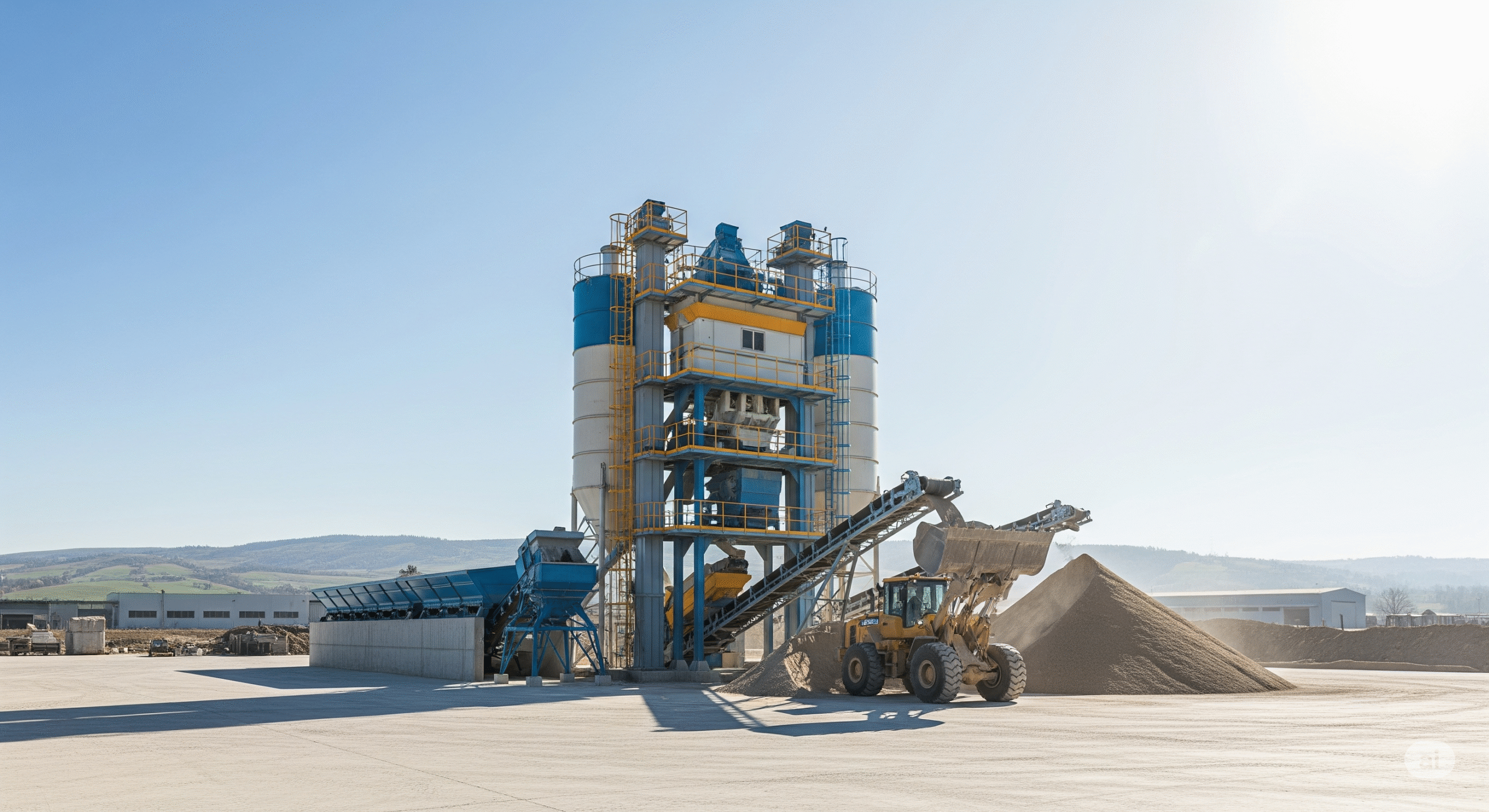
In a concrete batching plant, the gearbox is a speed-reducing and torque-multiplying unit installed between the electric motor and the drive pulley of the aggregate conveyor.
Its main function is to:
- Reduce the high-speed, low-torque output of the motor
- Convert it into low-speed, high-torque rotation
- Enable smooth and reliable movement of heavy aggregates (sand, gravel, crushed stone) up to the mixer
- Without a gearbox, the motor cannot directly drive the loaded conveyor belt.
Essentials of Gear Box:
- Operate under heavy load
- Face shock loading during material feeding
- Often work on inclined conveyors
- Run in dusty, harsh environments
The gearbox ensures:
- Adequate torque to start the belt under full load
- Controlled belt speed for accurate batching
- Long service life of motor and conveyor components
Types of Gearboxes Commonly Used
- a) Helical Gearbox (Most Common)
Used in: Horizontal and inclined aggregate conveyors
Features:
- High efficiency (95–98%)
- Smooth and quiet operation
- Suitable for continuous duty
- Compact and robust design
This is the standard gearbox used in most Concrete batching plant belt conveyors.
- b) Helical-Bevel Gearbox
Used when: Conveyor layout requires angular power transmission
Features:
- Combines helical and bevel gears
- Allows right-angle drive
- High torque capacity
- Excellent for space-restricted layouts
Used mainly where conveyor alignment or plant layout demands angular mounting.
Gearbox Construction (Basic Parts)
A typical conveyor gearbox consists of:
Input shaft – connected to the motor
Gear stages – helical or helical-bevel gears for speed reduction
Output shaft – connected to the drive pulley
Bearings – support shafts under heavy load
Housing – cast iron or fabricated steel casing
Lubrication system – oil bath lubrication for cooling and wear reduction
Seals – prevent dust and oil leakage
Typical Gearbox Characteristics in Batching Plants
Parameter Typical Range
Gear type Helical / Helical-Bevel
Input speed ~1440 rpm (motor speed)
Output speed 25–100 rpm
Reduction ratio 15:1 to 40:1
Power handling 5.5 kW to 37 kW (or more)
Duty Continuous, Heavy-duty
Mounting Foot-mounted / Flange-mounted
Mounting Arrangement
The gearbox is usually:
- Mounted on a rigid base frame
- Coupled directly to the drive pulley shaft or via coupling
- Protected with guards for safety
- Positioned at the head pulley (discharge end) of the conveyor
Advantages of Using Gearbox in Aggregate Conveyor
- High starting torque capability
- Smooth acceleration and deceleration
- Reduced motor stress
- Improved belt life
- Reliable operation under heavy load
- Lower maintenance compared to chain or direct drives
The gearbox in an aggregate conveyor is a critical mechanical component that enables efficient, safe, and reliable transport of aggregates to the mixer. Its ability to deliver high torque at low speed makes it indispensable in concrete batching plant conveyor systems.
Gearboxes in aggregate conveyor systems find primary applications in heavy-duty material handling where high torque at low speeds is essential for reliable transport of abrasive, high-density materials like crushed stone, gravel, and sand.
Primary Applications
- Concrete Batching Plants (Primary Use)
Gearboxes drive inclined aggregate conveyors that transport coarse/fine aggregates from storage bins to the mixer in continuous or semi-continuous batching operations.
Typical capacities: 30-120 tons/hour per conveyor lines.
- Stone Crushing and Screening Plants
Primary/secondary crushers → vibrating screens → stockpile conveyors use gearboxes sized for 200-1000 tons/hour throughput.
Multiple conveyor lines (feed, reject, product) require robust helical gearboxes to handle impact loads from rock falls.
- Ready-Mix Concrete (RMC) Plants
Similar to stationary batching plants but often mobile/compact. Gearboxes drive shorter, steeper conveyors (15-25° incline) feeding truck mixers or twin-shaft mixers with capacities up to 60 m³/hour.
Secondary Industrial Applications
- Mining and Quarrying
Overland conveyors and in-pit crushing-conveying (IPCC) systems transport overburden and ore. Long-distance systems (1-10 km) use high-power gearboxes (50-500 kW) in multi-drive configurations.
- Cement Manufacturing Plants
Raw material handling: Limestone, clay → crushers → raw mills via troughed belt conveyors. Gearboxes handle dusty, sticky materials with high abrasion resistance requirements.
- Asphalt Mixing Plants
Aggregate drying drums → hot stone elevators/conveyors → pug mill mixer. Gearboxes operate at elevated temperatures (up to 180°C ambient) with heat-resistant lubrication.
- Sand Washing and Aggregate Processing
Wet processing plants: Sand/gravel classifiers → dewatering screens → stockpile conveyors. Gearboxes must tolerate water spray and fines accumulation.
Specialized Applications
- Port and Stockyard Handling
Ship unloaders → stacker-reclaimers → yard conveyors for bulk aggregates. Tripper conveyors use gearboxes with variable speed drives for precise positioning.
- Recycling Plants
Construction & demolition (C&D) waste processing: Rubble → crushers → sorting conveyors → recycled aggregate stockpiles. Gearboxes handle mixed, contaminated loads.
- Railway Ballast Production
Quarry → crushers → screening → ballast loading conveyors. High-volume (500+ tons/hour) systems require gearboxes with overload protection for railcar loading surges.
The gearbox housing and internal parts are built from different materials, each chosen for strength, wear resistance, and durability in abrasive aggregate handling duty.
Main Materials of Construction
Housing and Covers
Cast iron (e.g., grey or ductile cast iron) for the main gearbox casing and end covers.
Provides good vibration damping, rigidity, and machinability for bearing seats and sealing faces.
Gears and Shafts
Alloy steel (carburizing steels) for gear wheels and pinions.
- Typical steels: low carbon alloy grades designed for carburizing + quench hardening, giving a hard wear resistant case (≈58–62 HRC) with a tough core for impact loads.
Medium/low alloy steel for shafts, often through hardened or induction hardened at journals and spline sections to resist bending and fatigue.
Bearings and Races
Bearing steel (high carbon chromium steel, e.g., 100Cr6) for rolling element bearings.
- Used in deep groove ball or tapered roller bearings that support radial loads from belt tension and axial thrust from helical gears.
Seals and Gaskets
Elastomers such as NBR (nitrile rubber) or FKM (Viton) for radial shaft seals and O rings.
- Provide oil retention and dust exclusion in cement/aggregate environments.
Fasteners and External Hardware
- Carbon steel or alloy steel bolts (often zinc plated or hot dip galvanized) for housing joints, mounting feet, and covers.
- Key material: medium carbon steel keys in shaft–hub connections.
Lubricant
Mineral or synthetic gear oil (e.g., ISO VG 150–320) is not a structural material but is critical for protecting gears and bearings against wear and pitting under continuous conveyor load.
In aggregate conveyor applications, this combination—cast iron housing, carburized alloy steel gears, hardened steel shafts and bearings, with oil lubrication and elastomer seals—provides the robustness and fatigue resistance needed for continuous, dusty batching plant service.
Working Principle of Gearbox
- Power Input from Electric Motor
A three-phase induction motor rotates at high speed (typically ~1440 rpm).
This high-speed rotation is transmitted to the gearbox input shaft via:
Flexible coupling, or Direct flange mounting
- Speed Reduction Inside the Gearbox
Inside the gearbox there are multiple stages of helical gears.
Each gear stage:
- Reduces rotational speed
- Increases torque proportionally
Helical gears are used because:
- Teeth engage gradually
- Load is shared across multiple teeth
- Operation is smooth and quiet
- Shock loads from aggregates are absorbed better
- Torque Multiplication
As speed decreases, torque increases.
This high torque is essential to:
- Start the conveyor belt under full aggregate load
- Overcome belt friction, material weight, and incline resistance
- Power Output to Drive Pulley
The gearbox output shaft is connected to the drive (head) pulley.
When the output shaft rotates:
- The drive pulley rotates
- Friction between pulley and belt moves the conveyor belt
This motion carries aggregates from the feed point up to the mixer.
- Continuous & Controlled Operation
Once running:
- The gearbox maintains constant belt speed
- Material flow remains uniform
- Mixer receives aggregates steadily for accurate batching
- The gearbox operates in continuous duty mode, designed for long operating hours.
- Lubrication & Heat Control
Gearbox gears rotate in an oil bath.
Lubrication:
- Reduces friction and wear
- Removes heat
- Protects gears and bearings from dust contamination
This ensures long service life in harsh batching plant environments.
- Load Handling & Shock Absorption
During aggregate feeding: Sudden load changes occur
Helical gear design:
- Absorbs shock loads
- Prevents jerks and vibration
- Protects motor and conveyor structure
Simplified Flow Diagram
Electric Moto (High speed, low torque)
↓
Gearbox (Speed reduction + torque increase)
(Low speed, high torque)
↓
Drive Pulley
↓
Conveyor Belt
↓
Aggregates to Mixer
Key features of the gearbox used in aggregate conveyor drives (such as in Concrete batching plants) can be grouped into design, performance, and application-specific characteristics.
Design Features
Helical (or helical–bevel) gear construction
Provides smooth, quiet meshing with multiple teeth in contact, giving high load-carrying capacity and low vibration compared to spur gears.
Multi-stage reduction
Two or three gear stages achieve overall ratios typically in the 10:1 to 25:1 range, converting a 1000–1500 rpm motor speed to about 60–150 rpm at the head pulley.
Robust housing and bearings
Cast-iron or heavy-duty alloy housings with tapered roller or deep-groove ball bearings support the high radial and axial loads from belt tension and helical gear thrust.
Performance Features
High torque output at low speed
Gear reduction multiplies motor torque many times, providing the starting and running torque needed to move fully loaded aggregate belts on an incline.
High efficiency
Helical gearboxes typically achieve 94–98% efficiency per stage, which is important for continuous-duty conveyor applications to limit power losses and heat generation.
Continuous-duty rating
Designed for S1 duty (continuous operation) with adequate thermal capacity, oil volume, and surface area for dissipation in 24/7 aggregate handling service.
Application-Specific Features for Aggregate Conveyors
Compact, flange/foot-mounted layout
Gearbox is arranged to mount directly on the conveyor head frame, with the output shaft coupled straight to the head pulley shaft to minimize alignment issues and space.
Sealed, dust-resistant construction (IP55 or higher)
Shaft seals and housing design prevent ingress of cement dust and fine aggregate, protecting gears and bearings in batching plant environments.
Shock-load capacity and service factor
Selected with a service factor typically 1.5–2.0 to withstand start-up loads, material surges, and occasional jams without gear or shaft failure.
Lubrication system suited to harsh duty
Oil-bath or splash lubrication with appropriate viscosity ensures a stable film on tooth flanks and bearings under variable load, temperature, and start–stop cycles.
Ease of maintenance and alignment
Standardized mounting feet or flanges, accessible drain/fill plugs, and provision for flexible couplings allow quick installation and servicing within the confined mixer platform area.
Together, these features make the gearbox a reliable “torque amplifier” tailored for dusty, abrasive, inclined aggregate conveyor duty in concrete batching plants.
Typical Gearbox Specifications (Conveyor Drive)
- Power Rating (Input)
This is the electric motor power range that the gearbox can be matched with — chosen based on belt size and material throughput.
Typical range: 4 kW – 300 kW (smaller plants use 5–30 kW; larger conveyors may use >100 kW)
- Gear Reduction Ratio
Defines how much the motor speed is reduced to conveyor speed:
Common ratios: 10:1 to 40:1
Can be customized depending on required belt speed and torque needs
- Output Speed
After reduction, this is the speed delivered to the drive pulley:
Typical output speeds: 20 – 300 rpm (most batching conveyors run in the lower part of this range)
- Output Torque
Torque capacity is what moves the heavy loaded belt:
Typical torque ranges (typical industrial conveyors):
800 Nm – 66,000 Nm for larger heavy-duty gearboxes
Smaller gearboxes for small conveyors: 50 Nm – 2000 Nm
(Torque depends heavily on conveyor size, belt width, incline angle, and throughput.)
- Gear Type
Helical gears (parallel shaft) — smooth, efficient, comfortable for batching plants
Helical-bevel gears — used when the drive direction changes or space constraints exist
- Mounting & Housing
Horizontal mounting is most common for belt conveyors
Can also be foot-mounted, flange-mounted, torque arm mounted, or shaft mounted depending on conveyor design
Housing material typically cast iron or fabricated steel (robust and suitable for dusty plant environments)
- Input & Output Shafts
Input designed for connection to motor (flange or keyed shaft)
Output shaft connects to conveyor drive pulley either directly or via coupling
Hollow and solid shaft options available
- Efficiency
High mechanical efficiency: 95 – 98 %
(Helical gearboxes are high-efficiency compared to worm types.)
- Operating Conditions & Service
Typical industrial conveyor gearboxes are designed for:
Continuous duty (S1)
Ambient operating — ~-20 °C to +40 °C
Protective seals to keep out dust and abrasive particles
Oil-bath lubrication for cooling and long life
Example Specification (Representative)
Parameter: Typical Value (Batching Plant Conveyor)
Power Rating: 7.5 – 30 kW (small–medium plants); 30 – 100 kW+ (large capacity)
Gear Type: Helical / Helical-bevel
Gear Ratio: 10:1 – 30:1
Output Speed: 25 – 100 rpm
Output Torque: 2000 – 10,000 Nm (depends on size)
Efficiency: 95 – 98 %
Mounting: Foot / Flange / Torque arm available
Housing: Cast iron / steel
Lubrication: Oil bath with breather
Operating Duty: Continuous
Actual values depend on the conveyor’s belt width (e.g., 800–1200 mm), aggregate load, incline angle, and desired belt speed.
How Specifications Are Selected in Practice
When designing or selecting a gearbox for an aggregate conveyor:
- Determine conveyor capacity (m³/hr or tons/hr)
- Choose belt width & speed (e.g., 1 m belt at ~1.5 m/s)
- Calculate required torque (based on material weight and incline)
- Choose motor power accordingly
- Match gearbox ratio to get desired output speed at the pulley
- This ensures the gearbox is neither oversized (wasted cost) nor undersized (early failure) — keeping batching accurate and reliable.