Pipe clamps (also referred to as hose clamps, line clamps, or pipeline supports) are mechanical fastening devices used to secure, support, and stabilize concrete pump discharge pipelines during the pumping and concrete delivery process. These specialized clamps are essential components in concrete delivery systems, serving to attach flexible hoses and rigid steel pipe sections to fixed structures while preventing movement, vibration, and potential damage to the pumping equipment and delivery lines.
Pipe clamps are essential mechanical connectors used in concrete pump pipeline systems to join, secure, and seal pipeline sections through which concrete is pumped from the pump to the placing point. They ensure a leak-proof, pressure-resistant, and safe connection between straight pipes, bends, reducers, and hoses.
In concrete pumping operations, the pipeline is subjected to high internal pressure, vibration, and abrasive wear caused by the movement of concrete. Pipe clamps are designed to withstand these harsh conditions while maintaining pipeline alignment and joint integrity throughout continuous pumping cycles.
Typically manufactured from high-strength forged or cast steel, concrete pump pipe clamps are used in conjunction with rubber sealing rings (gaskets) to prevent leakage at joints. They allow quick assembly and dismantling of pipelines on construction sites, improving operational efficiency and reducing downtime.
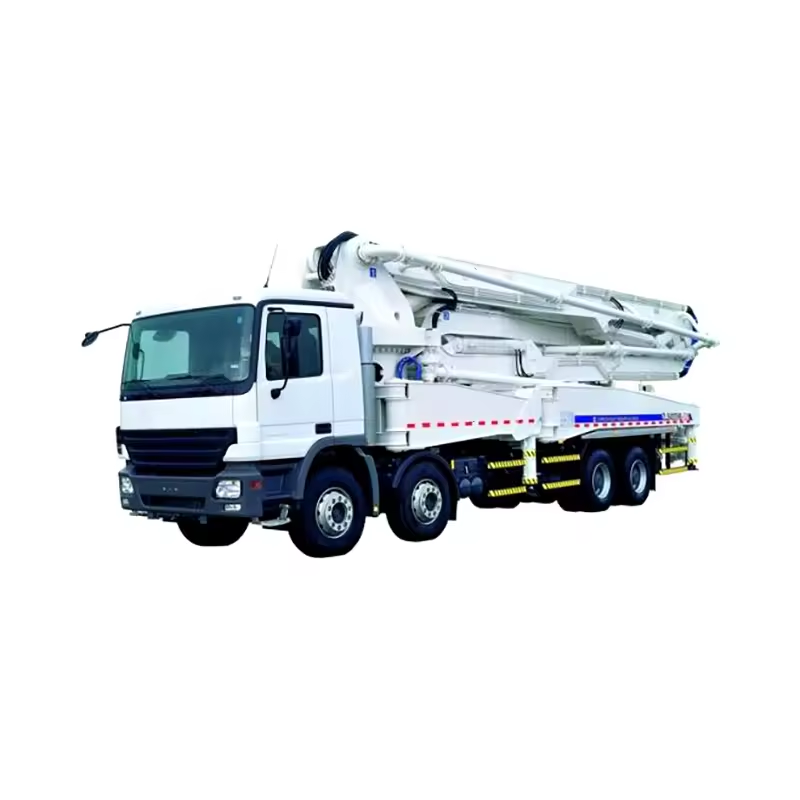
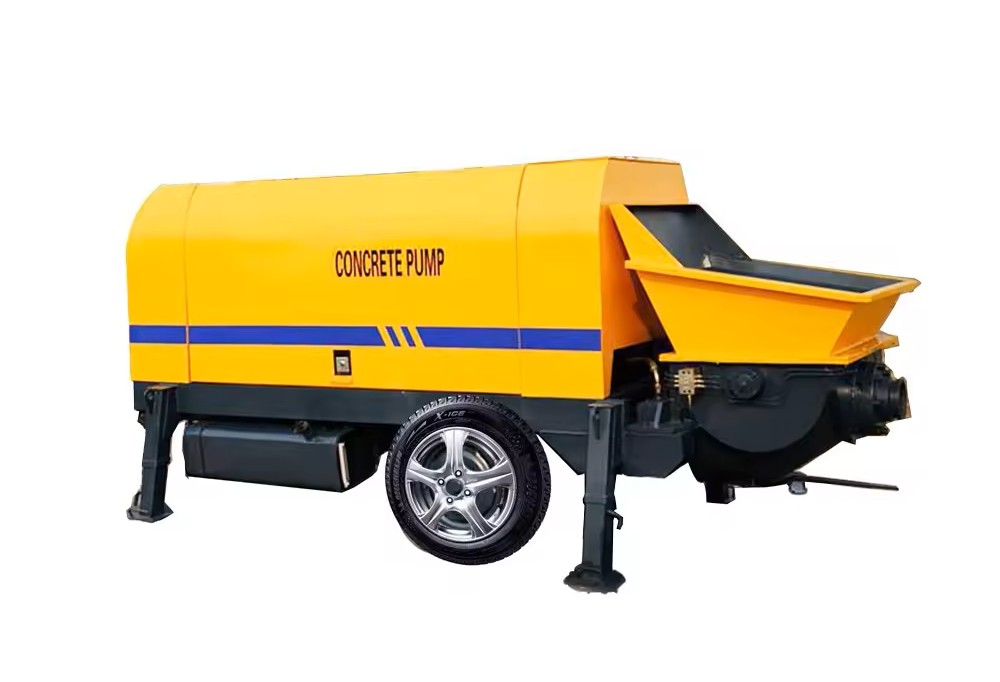
Pipe clamps are widely used in stationary concrete pumps, boom pumps, and trailer-mounted pumps, across applications such as high-rise buildings, bridges, tunnels, dams, and infrastructure projects. Their reliability is critical for ensuring safe concrete delivery, uninterrupted pumping, and consistent concrete quality.
In concrete construction operations, pump pipelines must reliably deliver pressurized concrete from the pump source to elevated or distant placement locations. Pipe clamps fulfill critical roles in maintaining pipeline integrity, safety, and operational effectiveness throughout concrete delivery operations.
Applications of Pipe Clamps in Concrete Pump Pipelines
Pipe clamps are essential components in concrete pumping systems, providing secure, leak-proof connections between pipeline sections. Their applications span a wide range of concrete pumping operations in construction projects.
- High-Rise Building Construction
- Used in pipelines for boom pumps delivering concrete to upper floors.
- Ensure leak-free joints under high pumping pressure.
- Enable rapid assembly and modification of vertical pipelines.
- Bridge and Flyover Projects
- Connect long pipeline sections across extended spans.
- Provide flexibility to assemble pipelines over water or obstacles.
- Withstand high-pressure pumping for long-distance concrete delivery.
- Tunnel and Underground Construction
- Secure joints in pipelines used for shotcrete or pumped concrete.
- Resist vibration and dynamic loads in confined spaces.
- Facilitate quick disassembly and relocation of pipelines as tunneling progresses.
- Dam and Hydro-Engineering Projects
- Used in large-diameter pipelines for mass concrete placement.
- Handle abrasive and high-volume concrete flow.
- Ensure continuous operation under extreme pumping pressures.
- Precast Concrete Plants
- Connect pipelines transferring concrete from central mixers to molds.
- Allow quick setup and dismantling for different casting stations.
- Maintain consistent flow and prevent leakage.
- Mobile and Trailer-Mounted Concrete Pumps
- Provide flexible connections between boom sections and hoses.
- Enable fast assembly on remote or temporary sites.
- Ensure safety and efficiency in mobile pumping operations.
- High-Pressure Concrete Pumping
- Suitable for long pipeline runs, including bends and reducers.
- Maintain pressure-tight connections for special concretes like high-strength or self-compacting concrete.
- Industrial and Infrastructure Projects
- Used in airports, metro stations, tunnels, and large factories.
- Allow flexible pipeline routing over obstacles and uneven surfaces.
- Support continuous pumping for large-scale operations.
- Maintenance and Retrofit Applications
- Replace worn-out or leaking clamps in existing pipelines.
- Upgrade pipelines for higher pressure or larger diameter requirements.
- Enable fast maintenance without dismantling the entire pipeline.
Pipe clamps are indispensable components enabling modern concrete construction methods across residential, commercial, infrastructure, and specialized applications.
Material of Construction for Pipe Clamps Used in Concrete Pump Pipelines
Pipe clamps for concrete pumping are designed to be robust, durable, and resistant to high pressure and abrasive wear. The materials are selected to ensure mechanical strength, corrosion resistance, and long service life.
- Clamp Body
- Forged Steel – High strength and toughness; resists impact and bending
- Cast Steel / Ductile Iron – Good wear resistance; suitable for heavy-duty applications
- Carbon Steel – Commonly used for standard clamps
- Bolts and Nuts
- High-Tensile Steel (Grade 8.8 or above)
- Ensures secure fastening under high pumping pressures and dynamic loads
- Often coated with zinc plating or anti-corrosion treatment
- Sealing Gasket
- Rubber (Nitrile or EPDM) – Flexible, leak-proof, and pressure-resistant
- Polyurethane (PU) – High abrasion resistance, suitable for high-pressure and abrasive concrete
- Ensures tight sealing between pipe ends and prevents leakage
- Surface Protection
Powder Coating or Industrial Paint – Protects steel or cast surfaces from rust and corrosion
Galvanization – Optional for outdoor use or corrosive environments
- Optional Wear-Resistant Inserts
Some heavy-duty clamps include steel or composite inserts at contact points to reduce wear from abrasive concrete flow
Summary
Clamp Body: Forged steel, cast steel, ductile iron
Fasteners: High-tensile steel bolts and nuts
Seals/Gaskets: Rubber (EPDM/NBR) or polyurethane
Surface Protection: Powder coating, paint, or galvanization
These materials ensure that pipe clamps can withstand high pressure, abrasive flow, vibration, and outdoor conditions, providing safe and durable joints in concrete pumping pipelines.
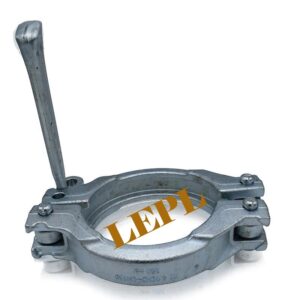
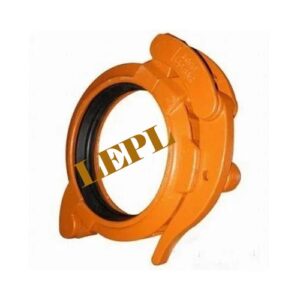
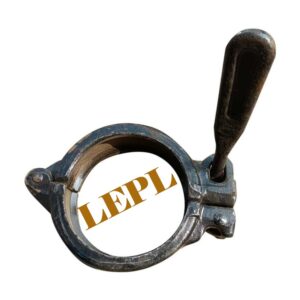
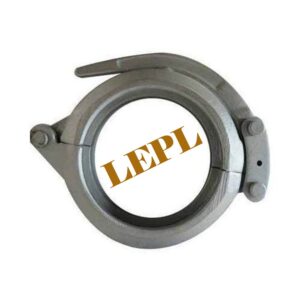
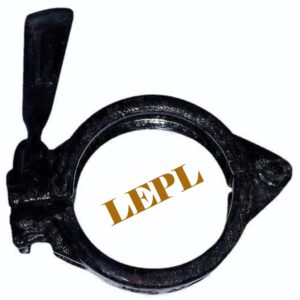
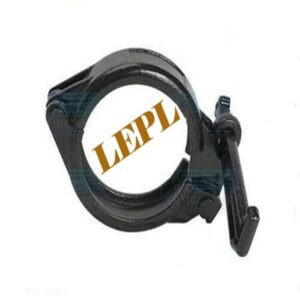
Pipe clamps in concrete pump pipelines work on the principle of mechanical locking and elastic sealing, ensuring a strong, leak-proof joint between pipeline sections under high pumping pressure.
Step-by-Step Working Principle
- Pipe Alignment
- Two concrete pump pipes (straight pipes, bends, or reducers) with welded pipe ends or flanges are aligned end-to-end.
- Proper alignment ensures uniform pressure distribution.
- Seal Placement
- A rubber sealing ring (gasket) is placed between the pipe ends.
- The gasket compensates for minor surface irregularities and provides an airtight and watertight seal.
- Clamp Positioning
- The pipe clamp is positioned around the joint.
- The clamp body fits into the grooved or flanged pipe ends.
- Mechanical Locking
- When the clamp bolt or locking lever is tightened:
- The clamp exerts radial force around the pipe joint.
- The pipe ends are pulled tightly together.
- This creates a rigid mechanical connection capable of resisting axial forces generated during pumping.
- Pressure Sealing Action
- As concrete pumping begins, internal pressure increases.
- This pressure further compresses the rubber seal, enhancing the leak-proof joint.
- The higher the pressure, the tighter the seal becomes (self-energizing effect).
- Vibration & Load Resistance
- The clamp absorbs vibrations and dynamic loads caused by concrete flow.
- Prevents joint separation during continuous pumping cycles.
Summary of Working Principles
Concrete pump pipeline clamps operate through integrated mechanical principles:
- Friction Mechanism: normal clamping force creates friction preventing pipe movement
- Load Support: distributed bearing reduces stress concentration and supports cantilever loads
- Pressure Resistance: radial restraint maintains pipe geometry against internal pressure forces
- Vibration Control: elastomeric elements and optimized spacing avoid resonance and dissipate energy
- Stress Distribution: multi-point contact prevents local yielding and fatigue
- Preload Maintenance: bolt tension continuously maintains clamping force
- Sequential Load Transfer: multiple clamps distribute forces along pipeline length
- Fatigue Prevention: cyclical load reduction extends component life
Key Features of Pipe Clamps Used for Concrete Pump Pipelines
Pipe clamps are critical for ensuring secure, leak-proof, and safe connections in concrete pumping systems. Their design focuses on durability, ease of use, and reliability under high-pressure, abrasive conditions.
- High-Strength Construction
- Made from forged or cast steel to withstand high pressures.
- Robust design resists impact, vibration, and bending loads during pumping.
- Pressure-Resistant Design
- Capable of handling high internal pressures generated by concrete pumps (typically up to 85 bar or more).
- Ensures leak-free joints even under continuous heavy-duty operation.
- Leak-Proof Sealing
- Equipped with rubber or polyurethane gaskets.
- Provides airtight and watertight sealing at pipe joints.
- Seal performance improves under pumping pressure (self-energizing effect).
- Quick Assembly and Disassembly
- Bolted or lever-lock design allows rapid installation and removal.
- Reduces pipeline setup time and downtime during cleaning or maintenance.
- Durability and Wear Resistance
- Designed to resist abrasion from concrete flow.
- Long-lasting under continuous vibration and high-pressure pumping.
- Flexibility and Compatibility
- Compatible with different pipe diameters, bends, and reducers.
- Allows modular pipeline layout and easy modifications on-site.
- Safety Features
- Prevents accidental separation under pressure.
- Rubber seals and sturdy clamps reduce hazardous leakage and spillage.
- Vibration and Load Absorption
- Absorbs dynamic forces and vibrations caused by pumping abrasive concrete.
- Reduces stress on pipeline joints and extends service life.
- Corrosion Protection
Coated or painted surfaces to resist rust and environmental corrosion, especially for outdoor sites.
- Low Maintenance
- Minimal upkeep required; only periodic inspection and replacement of gaskets or bolts.
- Enables safe and continuous pumping operations.
Summary
Pipe clamps combine mechanical strength, leak-proof sealing, quick installation, and durability, making them indispensable for concrete pump pipelines. They ensure safe, efficient, and uninterrupted concrete delivery across construction projects.
Specifications of Pipe Clamps Used for Concrete Pump Pipelines
Pipe clamps are designed to provide secure, leak-proof, and pressure-resistant connections in concrete pumping systems. Specifications vary according to pipe diameter, pressure rating, and application type.
Below is a typical specification guide used in the concrete pumping industry.
- Clamp Type
Feature Specification
Type: Standard hinged, bolted, or lever-lock clamp
Design: Two-piece hinged with bolts or lever-lock mechanism
Connection: Suitable for straight pipes, bends, reducers, and hoses
- Pipe Diameter Compatibility
Pipe OD Common Clamp Sizes
50 mm: Small diameter clamp
75 mm: Medium-small diameter clamp
100 mm: Medium diameter clamp
125 mm: Medium-large diameter clamp
150–200 mm: Large diameter clamp
Custom sizes: Available on request
- Pressure Rating
Type Max Operating Pressure
Standard clamp: Up to 60–70 bar
Heavy-duty clamp: Up to 85–100 bar
High-pressure special clamp: Above 100 bar (custom design)
- Material of Construction
Component Material
Clamp body: Forged steel / Cast steel / Ductile iron
Bolts & nuts: High-tensile steel
Gasket / Seal: Rubber / Polyurethane
Surface coating: Powder-coated / Painted / Galvanized (for corrosion resistance)
- Sealing & Leakage Control
- Integrated rubber or PU gasket for leak-proof joints
- Self-energizing sealing effect under internal concrete pressure
- Tolerates minor pipe misalignment
- Mechanical & Operating Features
Feature Specification
Assembly: Quick bolt or lever locking
Disassembly: Tool-free (for lever clamps) or with simple spanner
Operating Temperature: –10°C to +60°C
Vibration Resistance: High (absorbs dynamic loads from concrete flow)
- Durability & Maintenance
- Designed for abrasive concrete flow
- Minimal maintenance: periodic inspection of bolts and gasket
- Long service life under heavy-duty construction use
- Environmental & Safety
- Corrosion-resistant coatings for outdoor use
- Leak-proof joints ensure safe operation
- Compliance with construction and industrial safety standards
- Scope of Supply
- Pipe clamp assembly with bolts and nuts
- Rubber or polyurethane gasket
- Instruction manual for installation and maintenance
Summary
Pipe clamps are specified based on pipe diameter, maximum pressure, material strength, sealing type, and environmental conditions. Proper selection ensures safe, leak-free, and efficient concrete pumping for a wide range of construction projects.