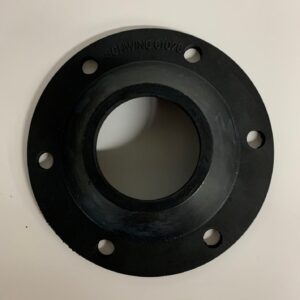
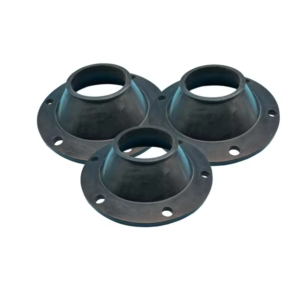
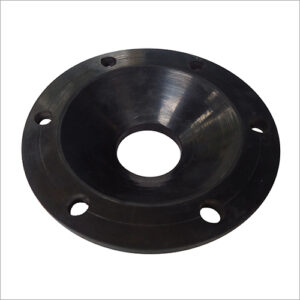
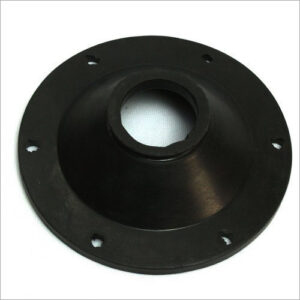
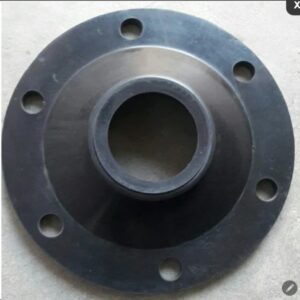
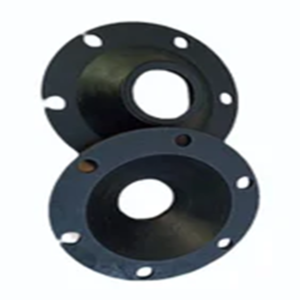
It is a circular rubber sealing component with bolt holes, installed in the valve sealing assembly of a concrete pump. Its main role is to create an elastic, pressure-tight seal between the S-tube and the wear plate, or to act as a buffer behind a metal sealing cone.
This design is very common in Putzmeister-, Schwing-, Sany-, Zoomlion-, XCMG-type S-valve systems.
- Sealing - Prevents concrete slurry leakage at high pumping pressures (often 80–120 bar).
- Elastic compensation - Rubber deforms to compensate for minor wear or uneven metal surfaces.
- Shock absorption - Reduces impact force when the S-valve switches sides.
- Wear protection - Extends the life of wear plate and metal sealing parts.
Materials used
Typically made from:
- Natural rubber (NR) or NBR
- Sometimes polyurethane (PU) for higher abrasion resistance
Typical properties:
- Hardness: 65–80 Shore A
- High elasticity
- Good resistance to cement slurry and water
Advantages of this rubber sealing cone
- Better sealing than metal-only cones
- Works effectively at lower hydraulic pressure
- Reduces noise and vibration
- Protects expensive metal wear parts
- Ideal for fine or high-slump concrete mixes
- Rubber becomes hard or brittle
- Cracks around bolt holes
- Edge tearing near the sealing face
- Increased concrete leakage
- Loss of elasticity (does not rebound when pressed)
Once elasticity is lost, sealing performance drops quickly.
Key features:
- Thick rubber body - Provides elasticity and sealing under high pressure.
- Central opening - Allows concrete flow through the valve passage.
- Multiple bolt holes - Used to fix or locate the rubber cone firmly in position so it does not rotate or shift during valve switching.
- Flat sealing surface - Presses tightly against the mating metal surface when hydraulic force is applied.
Where it is located
This rubber sealing cone is mounted:
- Between the S-tube sealing face and the wear plate, or
- Behind a metal sealing cone as a shock-absorbing and sealing layer
Hydraulic cylinders push the S-valve forward, compressing this rubber cone to form a leak-free seal.
Maintenance and replacement tips
- Inspect regularly during wear plate checks
- Do not overtighten bolts (causes premature cracking)
- Avoid oil or diesel contact
- Replace together with:
- Wear plate
- Cutting ring (recommended)
- Follow manufacturer hydraulic pressure limits
Typical service life
Depending on concrete mix and pressure:
- 8,000 – 25,000 m³ of concrete (can vary widely)
In simple terms
This rubber sealing cone is a flexible sealing and buffering part that ensures leak-free, smooth, and reliable operation of the concrete pump’s S-valve while protecting costly metal components.