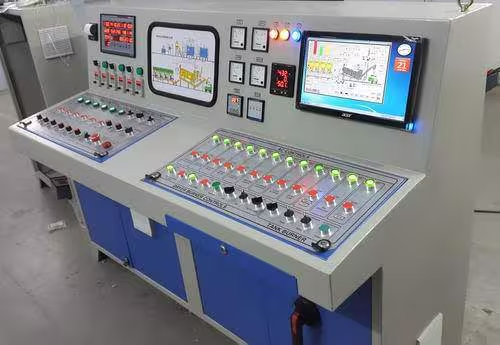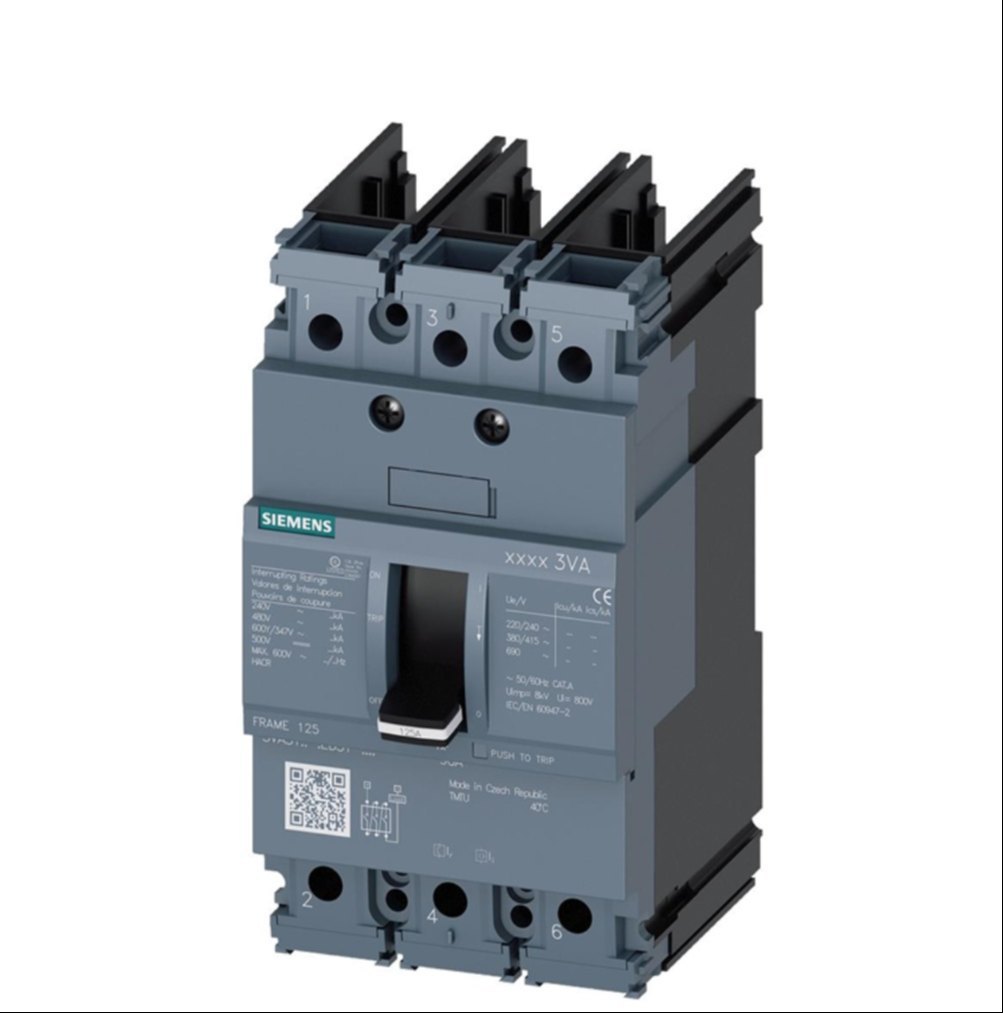
An MCCB (Molded Case Circuit Breaker) is an electrical safety device that automatically disconnects power when it detects abnormal current, such as an overload or short circuit. Its main purpose is to protect electrical equipment, cables, and people from damage caused by electrical faults.
Simple Analogy
Think of an MCCB as the main safety switch for a powerful electrical circuit.
- A fuse protects a circuit only once and must be replaced after it blows.
- An MCB (Miniature Circuit Breaker) protects smaller circuits, such as those in homes.
- An MCCB is designed for higher currents and industrial applications, and it can usually be reset after a trip.
An MCCB performs three main functions:
- Switches power ON and OFF manually.
- Protects against overloads by tripping if the current stays above the safe limit.
- Protects against short circuits by tripping almost instantly when a very high fault current occurs.
Example
Suppose a batching plant has a 100 HP motor that normally draws 120 A.
A 160 A MCCB is installed to protect the motor circuit.
- Normal operation: Current = 120 A → MCCB remains ON.
- Overload: Current increases to 180 A for several minutes → MCCB trips.
- Short circuit: Current suddenly rises to 5,000 A → MCCB trips immediately.
This prevents damage to the motor, cables, and electrical panel.
A 160A, 3-Pole MCCB (Molded Case Circuit Breaker) is widely used in industrial and commercial electrical systems to protect electrical circuits and equipment while also serving as a reliable switching device. It is commonly installed in main distribution boards, motor control centers (MCCs), and power distribution panels.
Applications of a 160A, 3-Pole MCCB
- Power Distribution Panels
One of the most common applications is protecting outgoing feeders from the main distribution board.
Example:
- Main LT Panel → 160A MCCB → Sub Distribution Panel
The MCCB protects the feeder cable and the downstream electrical system from overloads and short circuits.
- Concrete Batching Plants
Since you work in the RMC industry, this is a key application.
A 160A MCCB can protect the power supply to:
- Mixer motors
- Conveyor motors
- Cement screw conveyors
- Water pumps
- Air compressors
- Control panels
If any equipment develops a fault, the MCCB disconnects the circuit to prevent damage.
- Motor Protection
Large three-phase motors are often supplied through an MCCB.
Typical applications include:
- Compressors
- Pumps
- Crushers
- Blowers
- Mixers
- Conveyors
The MCCB provides:
- Short-circuit protection
- Overload protection (depending on the trip unit)
- Isolation for maintenance
- Manufacturer: Siemens
- Model: 3VL1716-1DD36-0AA0 (the standard Siemens ordering code is 1DD36)
- Type: Molded Case Circuit Breaker (MCCB)
- Frame Size: VL160X
- Rated Current (In): 160 A
- Poles: 3 Pole
- Rated Operational Voltage: Up to 690 V AC
- Breaking Capacity (Icu): 55 kA at 415 V AC
- Trip Unit: Thermal-Magnetic (TM), LI
- Overload Setting (Ir): Adjustable from 125 A to 160 A
- Short-Circuit Protection (Ii): 1500 A
- Terminal Type: Screw terminals
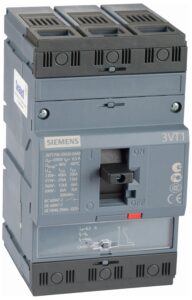
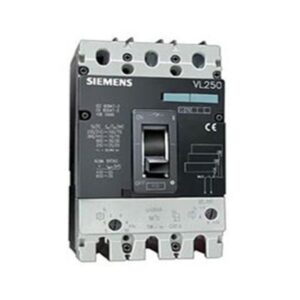
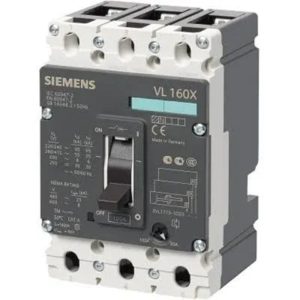
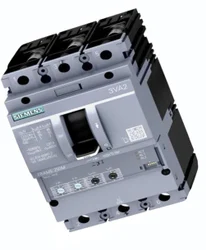
An MCCB (Molded Case Circuit Breaker) is an automatic electrical protection device that protects cables, motors, transformers, and other equipment from overload, short circuits, and, in some models, earth faults.
Here's how a 160A Siemens 3VL MCCB works:
- Normal Operation
- Electricity flows through the MCCB from the incoming terminals to the outgoing terminals.
- As long as the current remains below the set limit (for example, 160 A), the contacts stay closed and power flows normally.
- Overload Protection (Thermal Trip)
- If the current exceeds the rated value for a period of time (for example, 180–200 A), a bimetallic strip inside the MCCB heats up.
- The strip bends due to the heat and trips the breaker.
- This delayed action prevents nuisance tripping during temporary current surges but protects cables and equipment from overheating.
Example:
- Rated current: 160 A
- Load current: 190 A
- After a short time, the MCCB trips automatically.
- Short-Circuit Protection (Magnetic Trip)
- If a fault causes a very high current (such as several thousand amperes), an electromagnetic coil inside the MCCB operates almost instantly.
- The breaker opens its contacts in milliseconds, limiting damage to the electrical system.
Example:
- Normal current: 100 A
- Fault current: 5,000 A
- The magnetic mechanism trips immediately.
- Arc Extinction
When the contacts open under load, an electric arc forms between them. The MCCB contains an arc chute that splits and cools the arc until it is extinguished safely.
- Manual Reset
After the fault has been identified and corrected:
- Move the handle fully to the OFF position.
- Then move it to the ON position.
- Power is restored.
Internal Components
- Fixed and moving contacts – Carry and interrupt current.
- Thermal (bimetal) trip – Protects against overloads.
- Magnetic trip – Protects against short circuits.
- Arc chute – Safely extinguishes the electric arc.
- Operating mechanism – Opens and closes the contacts.
- Molded insulating case – Provides mechanical protection and electrical insulation.
Where a 160A 3-Pole MCCB is Used
A 160 A, 3-pole MCCB is commonly installed in:
- Electrical distribution panels
- Industrial control panels
- Concrete batching plants
- HVAC systems
- Motors and motor control centers
- Manufacturing plants
- Commercial buildings
The 3-pole design means it protects all three phases (R, Y, and B) of a three-phase electrical supply simultaneously. If a fault occurs on any phase, the MCCB disconnects all three phases together, helping protect both equipment and personnel.
A 3-pole MCCB is designed for three-phase power systems. It simultaneously switches and protects all three phases (R, Y, and B). If a fault occurs on any one phase, the breaker disconnects all three phases together, preventing unbalanced operation and reducing the risk of equipment damage.
A 160A MCCB is suitable when the maximum continuous load current is around 100–150 A, allowing some margin while ensuring the cables and connected equipment remain protected.
- Ready-Mix Concrete (RMC) plants
- Cement plants
- Engineering and manufacturing industries
- Steel fabrication units
- Chemical and pharmaceutical plants
- Food processing industries
- Textile mills
- Commercial buildings
- Hospitals
- Data centers
- Infrastructure projects
- Water treatment plants
The Siemens 3VL1716-1DD36-0AA0 (160A, 3-Pole MCCB) is a high-performance industrial circuit breaker designed for reliable protection and switching of electrical circuits. Its key features are outlined below.
Key Features of an MCCB
- Overload Protection
- Protects cables, motors, transformers, and other equipment from excessive current.
- Uses a thermal trip mechanism that trips when the current exceeds the preset value for a sustained period.
Benefit: Prevents overheating and insulation damage.
- Short-Circuit Protection
- Instantly disconnects the circuit when a high fault current occurs.
- Uses a magnetic trip mechanism for rapid operation.
Benefit: Minimizes equipment damage and reduces fire risk.
- High Breaking Capacity
- Can safely interrupt very high fault currents without being damaged.
- The Siemens 3VL series offers high interrupting capacity suitable for industrial applications.
Benefit: Protects equipment even during severe electrical faults.
- 3-Pole Protection
- Simultaneously switches and protects all three phases (R, Y, and B).
Benefit: Prevents unbalanced operation in three-phase systems.
- Resettable Design
Unlike a fuse, an MCCB can be reset after the fault has been cleared.
Benefit: Reduces downtime and replacement costs.
- Manual Switching
Can be used as a manual ON/OFF isolator for maintenance or operational purposes.
Benefit: Provides safe isolation of electrical equipment.
- Adjustable Trip Settings
Many MCCBs allow adjustment of:
- Overload current
- Time delay
- Instantaneous trip current
Benefit: Protection can be tailored to the specific application.
- Compact Construction
Designed to fit into electrical panels while handling high current ratings.
Benefit: Saves panel space.
- Durable Construction
Manufactured using high-quality insulating materials and robust internal components.
Benefit: Long service life with minimal maintenance.
- Arc Extinguishing System
When the breaker opens under load, an electric arc forms. The built-in arc chute safely extinguishes it.
Benefit: Protects the contacts and improves operational safety.
- Visual Status Indication
The operating handle clearly shows whether the breaker is:
- ON
- OFF
- TRIPPED
Benefit: Makes fault identification and troubleshooting easier.